Statutory information
Hallmarking
A hallmark is not a brand stamp and not a quality badge. It is an independent test result, struck into the metal by a UK assay office, and above a certain weight the law requires one before an article can be described and sold as silver.
Last updated 12 August 2026
Why a hallmark exists
You cannot tell the purity of a precious metal by looking at it. Sterling silver, silver-plated base metal and a silver-coloured alloy with no silver in it can be visually indistinguishable, and the difference in value is enormous. Hallmarking exists because the only reliable way to know is to have the metal independently assayed.
Under the Hallmarking Act 1973 it is a criminal offence in the United Kingdom to describe an article as gold, silver, platinum or palladium in the course of trade, above the statutory exemption weight, unless it carries a hallmark from a UK assay office. That applies to us as the seller, not to you as the buyer.
We have built that requirement into the site rather than into a policy document. Every article publishes its silver weight in grams. An article of silver over 7.78 g that is not hallmarked is not rendered by this storefront at all, and neither is any metal article whose weight we cannot state.
What the marks are
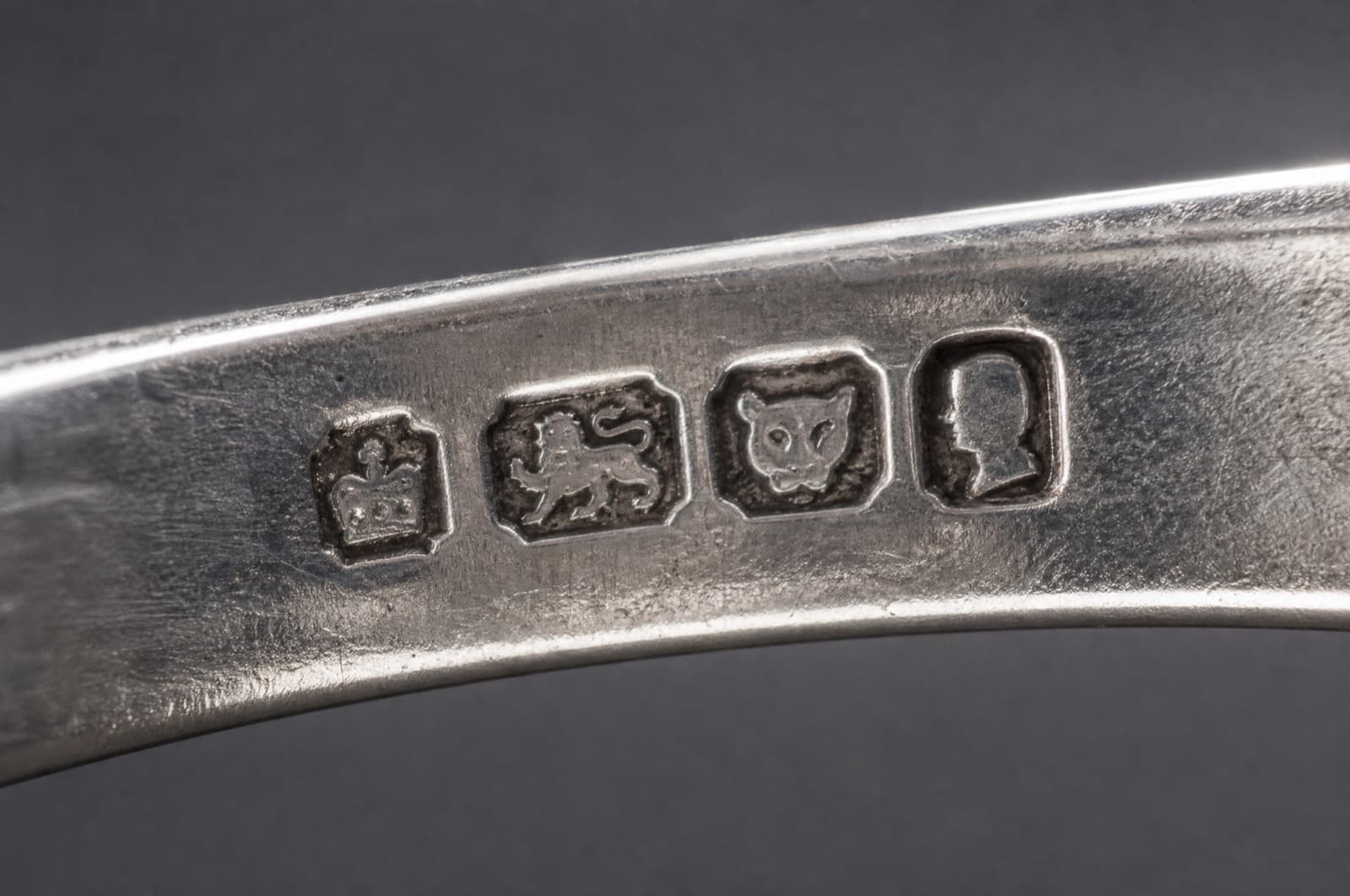
Struck, not printed
A hallmark is punched or laser-marked into the surface, so it sits below the plane of the metal and catches light along one edge. Anything printed, etched onto a sticker, or applied to a swing tag rather than the metal is not a hallmark.
A complete UK hallmark is a group of marks read together, not a single symbol.
| Mark | Status | What it tells you |
|---|---|---|
| Sponsor's mark | Compulsory | The registered mark of the company or person who submitted the article for assay. It is unique, registered with an assay office, and is the traceable link back to whoever put the article into the market. |
| Fineness (purity) mark | Compulsory | The metal and its fineness in parts per thousand. Sterling silver is 925 — that is 925 parts silver in every 1,000, with the balance normally copper. The number is what makes 'sterling' a legal statement rather than a marketing one. |
| Assay office mark | Compulsory | Which of the four UK assay offices tested and struck the article: a leopard's head for London, an anchor for Birmingham, a rose for Sheffield, a castle for Edinburgh. |
| Date letter | Optional since 1998 | A letter in a shaped shield showing the year the article was assayed. It is no longer compulsory, so its absence tells you nothing about whether the article is properly marked. |
Reading one on the piece in your hand
- Find the mark. On a ring it is on the inner wall. On a chain or bracelet it is on a small flat tag beside the clasp. On a bangle or cuff it is on the inner face.
- Use magnification. A 10× jeweller’s loupe is the standard tool; a phone camera at full zoom under a bright lamp will usually do. The marks are typically 1 mm tall or less.
- Light it from the side, not the front. A hallmark is an indentation, so it becomes readable when light rakes across it and throws a shadow into the punch.
- Read the group left to right and identify each mark against the table above. Look for the fineness number first — on our pieces it will read 925.
- If you want independent confirmation, the assay office that struck the article will identify its own mark, and a jeweller with a loupe will read it for you in seconds.
Statutory exemption weights
Below these weights an article may legally be described and sold as the metal without a hallmark. The weights are set in law and are the same for every UK retailer.
| Metal | Exemption weight | Sold here |
|---|---|---|
| Silver | 7.78 g | Yes — the entire catalogue |
| Gold | 1 g | No |
| Platinum | 0.5 g | No |
| Palladium | 1 g | No |
The weight that matters is the weight of the article, not of the order. A set containing a 9.8 g chain and a 4.6 g band is assessed as two separate articles: the chain must be struck, the band need not be.
Dealer's Notice
UK dealers in precious metals are required to display the notice explaining approved hallmarks. Its content is reproduced below.
Statutory notice
Information on UK hallmarks
It is an offence for any person in the course of a trade or business to describe an unhallmarked article as being wholly or partly made of gold, silver, platinum or palladium, or to supply unhallmarked articles to which such a description is applied. The following weights are exempt from hallmarking:
- Goldunder 1 gram
- Silverunder 7.78 grams
- Platinumunder 0.5 grams
- Palladiumunder 1 gram
Approved hallmarks struck by the four UK assay offices — London, Birmingham, Sheffield and Edinburgh — consist of a sponsor’s mark, a fineness (purity) mark and an assay office mark. A date letter may also be applied, but has been optional since 1998. Hallmarks struck by an assay office within the international hallmarking convention, and certain marks struck within the European Economic Area, are also legally recognised in the United Kingdom.
The official illustrated version of this notice is issued by the British Hallmarking Council and is displayed alongside this text at our business address. If you would like a copy, or the marks read on an article you already own, contact support@thejewellersuk.shop.
Which pieces here are struck
9 of the 42 articles in this catalogue exceed the 7.78 g exemption weight and therefore carry a full UK hallmark. The heaviest exempt article is 7.2 g — under the line, and stated as such on its own page.
| Article | Silver weight | Assay office |
|---|---|---|
| Curb Chain 2.5 mm | 9.8 g | Birmingham |
| Rope Chain 2 mm | 8.4 g | Birmingham |
| Belcher Chain 3 mm | 14.2 g | London |
| Herringbone Chain 3 mm | 12.6 g | Sheffield |
| Curb Bracelet 5 mm | 12.4 g | Birmingham |
| Plain Bangle 3 mm | 8.9 g | Sheffield |
| Plain Bangle 5 mm | 15.2 g | London |
| Cuff Open 6 mm | 10.4 g | Birmingham |
| The Worn-In Set | 16.0 g | Birmingham |
The date letter is optional and varies by production batch, so we do not print a year against a listing — read it from the piece itself, where it will be accurate. See all 8 articles above the exemption weight.
An unmarked piece is not an un-silver piece
Most of this catalogue is legally exempt, and that is not a compromise. A 2.4 g chain is exempt because 2.4 g is below 7.78 g, not because there is anything different about the metal. Every article here is solid 925 sterling throughout.
What the exemption does mean is that you have to take the seller’s word for the alloy on lighter pieces — which is exactly why we publish the weight of every article rather than only the ones where the law forces our hand. If you would like a lighter piece independently assayed, any UK assay office will do it for a fee.
We sell no plated, filled, bonded or silver-tone items of any kind. Nothing in this catalogue has a base-metal core.