Sizing
Ring size and lengths
UK letters with the internal circumference in millimetres beside them, because a letter on its own is not a measurement. Two ways to work out your size at home, and an honest note on why the answer changes through the day.
Last updated 12 August 2026
UK size table
The UK scale runs in letters, stepping roughly 1.25 mm of internal circumference per full letter. Half sizes exist between them. Our bands are cut to ±0.3 mm.
| UK size | Inside circumference | Inside diameter |
|---|---|---|
| F | 45.5 mm | 14.5 mm |
| G | 46.8 mm | 14.9 mm |
| H | 48.0 mm | 15.3 mm |
| I | 49.3 mm | 15.7 mm |
| J | 50.0 mm | 15.9 mm |
| K | 51.9 mm | 16.5 mm |
| L | 52.5 mm | 16.7 mm |
| M | 53.8 mm | 17.1 mm |
| N | 55.1 mm | 17.5 mm |
| O | 56.3 mm | 17.9 mm |
| P | 57.6 mm | 18.3 mm |
| Q | 58.9 mm | 18.8 mm |
| R | 60.2 mm | 19.2 mm |
| S | 61.4 mm | 19.6 mm |
| T | 62.7 mm | 20.0 mm |
| U | 64.0 mm | 20.4 mm |
| V | 65.3 mm | 20.8 mm |
| W | 66.6 mm | 21.2 mm |
| X | 67.8 mm | 21.6 mm |
| Y | 69.1 mm | 22.0 mm |
| Z | 70.4 mm | 22.4 mm |
Measuring the finger itself
- Cut a strip of paper about 6 mm wide, or use a length of non-stretch thread.
- Wrap it around the base of the finger you will wear the ring on. Snug, not tight — you should be able to slide it slightly.
- Check it passes over the knuckle. A ring has to get past the knuckle to reach the base, and on many people the knuckle is the larger of the two.
- Mark where the strip overlaps and measure the length in millimetres against a ruler.
- Find that figure in the circumference column above. If you fall between two letters, take the larger.
Do not use a tape measure that stretches, and do not measure over a plaster or a swollen joint. Send us the measurement and we will tell you which letter we would cut.
From a ring you already own
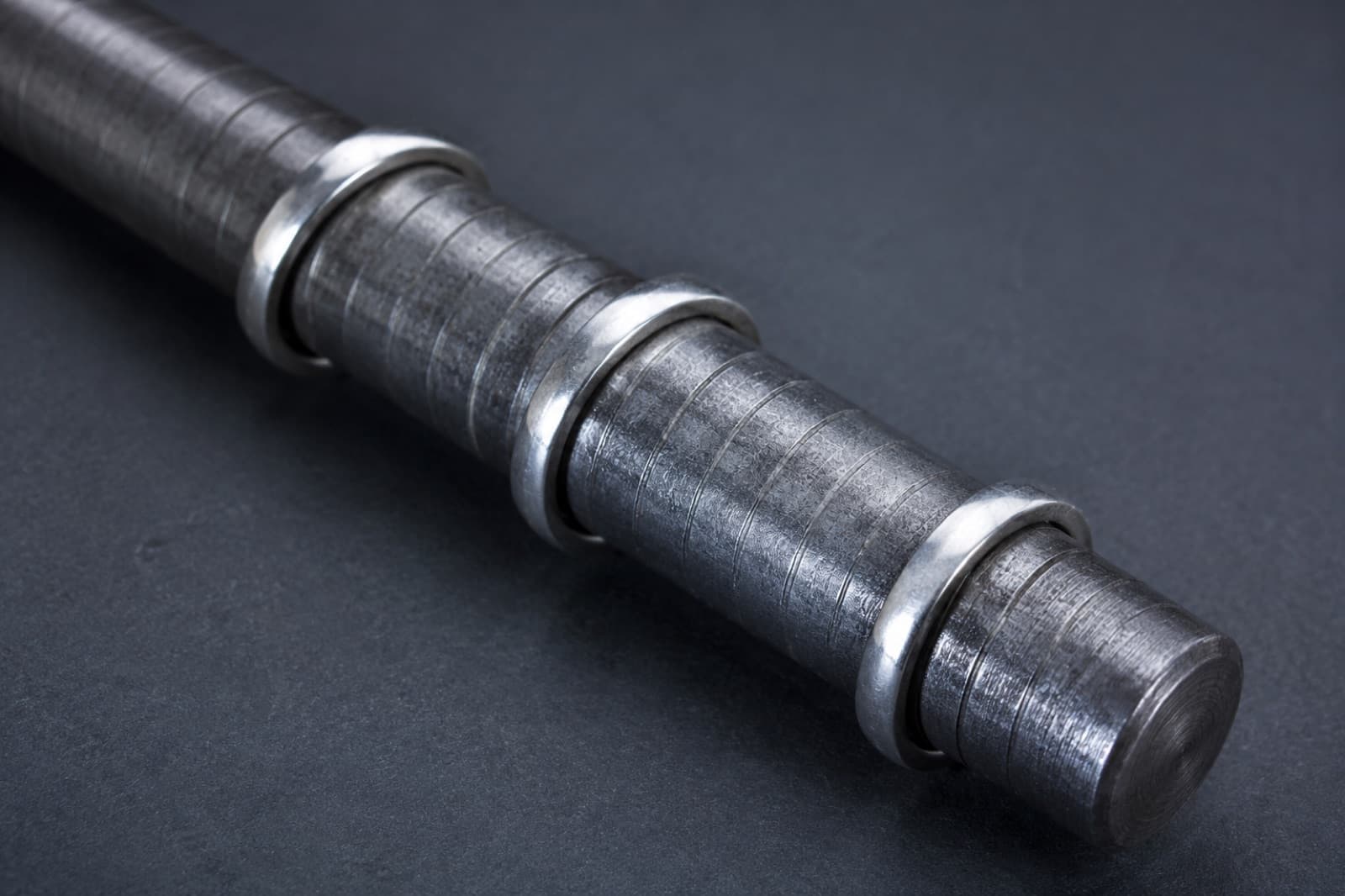
A mandrel reads a ring directly. At home, a ruler across the inside of the band gets you close enough.
- Take a ring that fits the correct finger and lay it flat.
- Measure straight across the inside, from inner edge to inner edge, in millimetres. That is the inside diameter.
- Match it to the diameter column above. Measure twice — a 0.4 mm error is a full size.
If you only have a circumference, divide it by 3.14 to get the diameter; if you only have a diameter, multiply by 3.14 to get the circumference.
Your fingers are not one size
This is the part most size guides leave out, and it is the most common reason a ring feels wrong on arrival.
- Temperature. Fingers shrink in the cold and swell in the heat. The difference between a January morning and an August afternoon is commonly half a size or more.
- Time of day. Fingers are smallest first thing and largest in the evening.
- Activity, salt and hydration. Exercise, a salty meal and long flights all cause swelling.
- Hands are not symmetrical. Your dominant hand is usually a little larger.
Measure at the end of a normal day, at room temperature, when your hands are neither cold nor swollen. Measure three times on three different days if the piece matters.
Band width changes the size you need
A wide band has more surface in contact with the finger, so it fits more tightly at the same nominal size and has to pass a knuckle over a greater distance.
- 2 mm and 3 mm — take your measured size.
- 4 mm and 5 mm — consider going up a quarter to a half size.
- 6 mm — go up a half size, and expect it to feel firm at first.
- Stacking two or more bands on one finger — size the stack as a group, not each band individually.
We resize plain bands up to two sizes either way for a quoted fee. A resized ring is an altered article and cannot then be returned under the right to withdraw, so it is worth getting the first order right.
Chain lengths
Necklace lengths are measured end to end including the clasp.
| Length | Imperial | Where it sits |
|---|---|---|
| 40 cm | 15.7 in | At the base of the throat. The tier nothing else tangles with. |
| 45 cm | 17.7 in | On or just below the collarbone. The most common single-chain length. |
| 50 cm | 19.7 in | Below the collarbone, above the sternum. The first layering drop. |
| 55 cm | 21.7 in | At the sternum. Sits under everything else in a stack. |
To layer two chains, put at least 5 cm between them so they cannot sit on top of each other and tangle. The Stack Builder applies that rule automatically. If you are between tiers, the 5 cm extender moves any chain down one step.
Bracelets are 18 cm, 19 cm and 20 cm; the anklet is 25 cm. Measure your wrist snugly and add 1.5–2 cm for a chain bracelet that turns comfortably.